Valkure — VR Cybersecurity UX Research
UX research for a VR platform visualizing hybrid cloud networks — 4 expert interviews, 2 rounds of usability testing, thematic analysis, and a pivotal finding that redirected the product strategy.
UX Researcher + Interaction Designer — room acquisitions, participant incentives, usability test questions, and data coding. 10-week capstone, team of 4 at University of Washington HCDE.
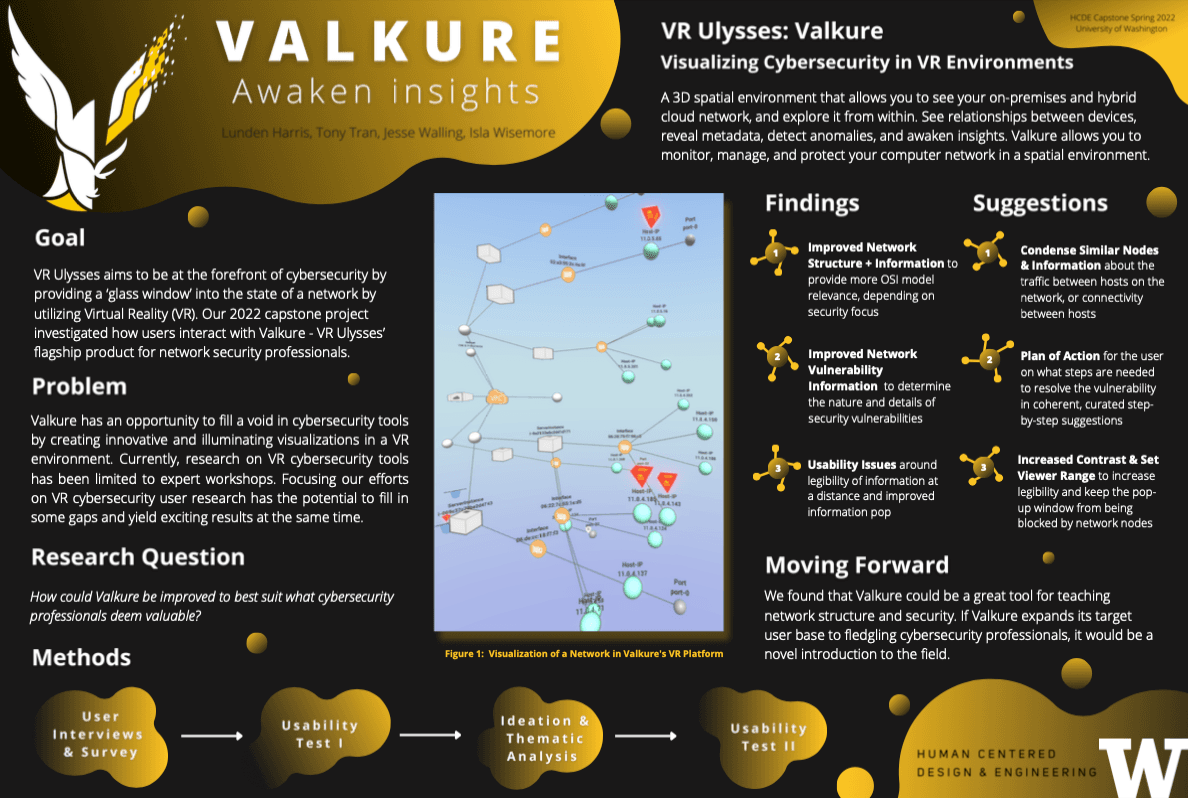
Capstone research poster — HCDE @ University of Washington, Spring 2022
the problem
Cybersecurity professionals rely on fast-moving log files and 2D visualizations to monitor networks. VR Ulysses built Valkure — a 3D spatial environment for network security — but had no usability data on whether professionals would actually find it valuable or integrate it into their workflow.
The research question: how could Valkure be improved to best suit what cybersecurity professionals deem valuable?
research process
Phase 1
Exploratory
4 semi-structured interviews with cybersecurity professionals (3–20 years experience) covering current tools, visualization pain points, and openness to VR.
Phase 2
Usability Test I
3 professionals tested Valkure's web demo, completing tasks like identifying vulnerabilities and exploring network nodes while thinking aloud. We transcribed all sessions and ran thematic analysis in Miro, color-coding codes by participant and grouping by theme.
Phase 3
Ideation
We synthesized findings into design recommendations and presented them directly to VR Ulysses.
Phase 4
Usability Test II
We pivoted the participant profile to early-career security students (UW's Batman's Kitchen defense team) to test an emerging hypothesis about Valkure's educational potential.
recommendations
Current Product Recommendations
- ✦Condense node separation to reflect the OSI model more intuitively
- ✦Surface contextual vulnerability information with clear severity and remediation steps
- ✦Fix contrast and legibility issues inaccessible to users with any vision variation
- ✦Anchor info popups to the user's viewing position rather than the node's location
- ✦Support multi-source consultation through a VR HUD or background 'monitors'
Strategic Recommendation
- ✦Pivot Valkure's target audience from industry professionals to newcomers in the field
- ✦Professionals found the 3D visualization novel but couldn't justify replacing existing tools
- ✦Students found it intuitive, explorable, and more engaging than 2D network diagrams
- ✦Points to a strong educational use case
key features
- ✦4 semi-structured interviews with cybersecurity professionals (3 to 20 years experience)
- ✦Thematic analysis in Miro — codes color-coded by participant, grouped by Critical Issues / Useful Features / Tweaks
- ✦Usability Test I — 3 professionals tested web demo with think-aloud protocol
- ✦Usability Test II — 3 early-career students tested VR platform in-person with Quest headsets
- ✦Key finding: professionals skeptical of VR workflow fit; students found 3D networks more intuitive than 2D
- ✦Identified vulnerability information as critically underdeveloped — users couldn't determine severity or next steps
- ✦Documented accessibility failures: low contrast between light gray and yellow UI states, text illegible at distance
- ✦Strategic pivot recommendation: reposition Valkure as a cybersecurity education and training tool
- ✦Design recommendations delivered to VR Ulysses as a live presentation with Q&A
timeline
Academic capstone project — University of Washington HCDE Spring 2022